
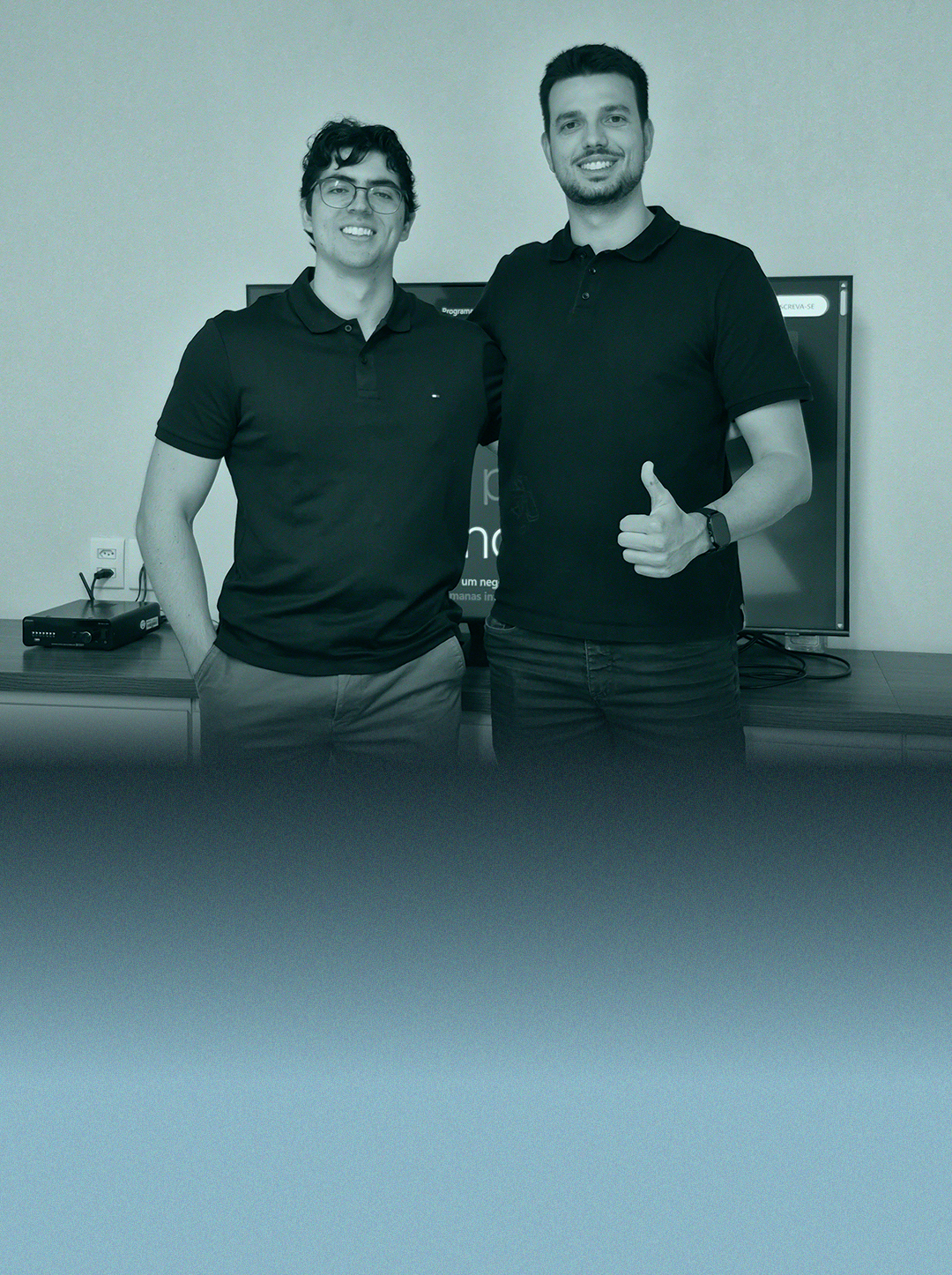
Bruno didn't start out thinking about a startup. He started thinking about finishing a graduation project
In my undergraduate degree in Mechanical Engineering, I had to test hundreds of wind turbine configurations for my final exam. Each scenario required more than 100 steps to reach the final result. It was an endless loop of clicks and patience. I looked for something ready-made, software that would make the process easier while I concentrated on what really required "engineering". But what I found was a void. There were excellent tools for specific steps, but there was no operator to connect the entire flow from end to end in the practical, reliable and scalable way I needed.
As the project evolved, it became clear that the challenge was not just to run more simulations. It was to make the computational engineering cycle more efficient. And when you solve this for real, the impact is not restricted to the academic environment.
When I entered the market, I saw the same pain repeated. Senior engineers spending almost half their time doing what I did in my CBT: setting up simulations manually, moving data between software that doesn't talk to each other and keeping an eye on progress bars.
During conversations, I received the feedback that would define the creation of AI Engineerings. Large companies hire expensive developers just to solve the problems of inefficiency in simulations. But the complexity of projects demands a speed that the human brain alone cannot keep up with. Dependence on manual processes creates a glass ceiling: to innovate more, you need to hire more. In a world of scarce and expensive talent, this doesn't add up.
That's when I decided that if no one had created a software process facilitator for engineering, I would use the script I had written to solve my problem and turn it into a product. And I wouldn't do it alone.
Together with Matheus, my friend and colleague since high school and also a Mechanical Engineering graduate, we founded AI Engineerings. Our mission was clear: to eliminate waste in complex engineering processes so that companies could focus on what really matters, innovation.
The engineering process facilitator
It is into this efficiency vacuum that AI Engineerings introduces Maverick. We're not talking about yet another off-the-shelf piece of software or a complex tool that requires months of implementation. Maverick is a paradigm shift. It's a process facilitator, designed to unblock your team's workflow with a few clicks.
The market today is saturated with promises about Artificial Intelligence, but most of them boil down to text or image generators. At AI Engineerings, we don't do buzzwords. We deliver AI Agents designed to take on the hard work of engineering and find the best results.
What sets Maverick apart from conventional solutions is our proprietary "Automation by Observation" technology. While the market tries to force integrations via complex and unstable APIs, Maverick "learns" your team's workflow. It observes how your experts interact with the tools and facilitates execution, removing operational friction. What used to take weeks of manual configuration can now be done in minutes, allowing engineers to focus on what really matters: strategic decisions.
Unlocking market speed
We know that for commercial and strategic decision-makers, the question is not "how does the code work", but "how much time do we gain". In sectors such as automotive or renewable energy, being the first to validate a design can mean winning billion-dollar contracts.
Maverick doesn't just automate, it performs product optimization on a superhuman scale. Our AI is capable of scanning thousands of design possibilities automatically, finding solutions that would otherwise go unnoticed. In practical terms, we're talking about an operation up to 10 times faster than traditional optimization methods on the market.
Imagine reducing a validation cycle of 100 setups from one week to just two days, using just one computer. That's not a theoretical projection; it's the delivery standard that Maverick is already setting.
From one engineer to another
We know that deployment needs to be accompanied by security, which is why our solution was built to be useful in large corporations. It acts as a plugin, respecting the software infrastructure the company already has and protecting the company's intellectual property.
Because we are a company "by engineers for engineers", the aim is always to stay close to the client. Whenever possible, we propose an onboarding between the two teams focused on ensuring that the company achieves maximum ROI in the shortest possible time. The focus is on reducing structural cost and transforming the engineering department from a heavy cost center into an agile revenue-generating engine.
The impact of implementation
When you look at Maverick as a product, it's not just automation. It's a way of making complex processes repeatable and scalable. And that changes the game: the company learns faster, tests more hypotheses and makes more informed decisions, without burdening the right people with operational work.
That's how a need from my CBT turned into a product. And that's how Maverick started to become a business solution with a real place in high-level engineering.
Because, in the end, the pain is the same on any scale: an engineer shouldn't spend the better part of a day doing work that a machine can repeat. The Maverick was born to take on that part and free up the rest for what really requires an engineer.
The next step:
A company is not only built with a product and a dream, but with partnerships and structure. We are very proud that AI Engineerings has been selected for Montreal Ventures' MOVE Track program. We are ready to help companies reach the next frontier of engineering productivity.
The future of engineering will be made easier. And it starts with the Maverick.
Bruno Fracaro, CEO of AI Engineerings.
 English
  Portuguese